Why We Love Jordan: The Kingdom That Wins Every Heart
From Petra and Wadi Rum to mansaf and legendary hospitality, the reasons Jordan wins every heart, what the country is known for, and why it's worth visiting.
A rose-red temple carved into a desert cliff. A valley of red sand where astronauts trained for Mars. A sea so salty you float without trying. And, threaded through all of it, a people who will pull a stranger in for tea and call them family within the hour. This is Jordan, a small kingdom that holds an outsized share of the world's wonders, and one that has a way of turning first-time visitors into lifelong admirers. Two words sum up how many of us feel about it: I ❤️ Jordan.
But what exactly is Jordan known for, and why does it win so many hearts? This is a love letter to the Kingdom, its ancient wonders and dramatic landscapes, its long history at the crossroads of the world, its legendary hospitality and unforgettable food, its safety and warmth, and the flag that flies proudly over it all, plus the I Love Jordan T-Shirt that lets you wear that love on your chest.
What is Jordan known for?
Jordan is a small Arab kingdom in the heart of the Middle East, bordered by Saudi Arabia, Iraq, Syria, Palestine and Israel, with a single short coastline on the Red Sea. Officially the Hashemite Kingdom of Jordan, it is home to around eleven million people, ruled as a constitutional monarchy, and famous as a stable, welcoming island in a turbulent region. Its capital is Amman, and Arabic is its language.
Above all, Jordan is known for Petra, the ancient Nabataean city and one of the New Seven Wonders of the World, but that is only the beginning. In a country smaller than many single American states, you can stand in a Roman city, float in the lowest place on Earth, sleep under the stars in a Mars-like desert, dive a coral reef and walk through three thousand years of biblical and Islamic history, all within a few hours' drive. Few places pack so much into so little space.
A land of wonders
Jordan's greatest gift is its variety. Each of its landmarks could anchor a trip on its own, and together they make the country feel far larger than the map suggests:
- Petra, the rose-red city carved into the rock by the Nabataeans, entered through a narrow canyon that opens onto the famous Treasury.
- Wadi Rum, the Valley of the Moon, a vast desert of red sand and towering sandstone where you can sleep in a Bedouin camp under a sky thick with stars.
- The Dead Sea, the lowest point on Earth, where the mineral-rich water is so salty you float effortlessly on your back.
- Jerash, one of the best-preserved Roman provincial cities anywhere, with colonnaded streets, temples and theatres.
- Amman, the white-stone capital on the hills, where a Roman theatre and hilltop temple sit among modern cafés and souks.
- Aqaba, the Red Sea city of coral reefs and warm winter beaches, gateway to the south.
Beyond these, there is Mount Nebo where Moses is said to have looked out over the Promised Land, the mosaic city of Madaba, the desert castles of the eastern steppe, the Baptism Site on the Jordan River, and the green hills and Roman ruins of the north. Jordan rewards the curious at every turn.
A crossroads of history
Part of why Jordan feels so rich is that almost everyone passed through it. Sitting on the land bridge between Arabia, the Mediterranean and Mesopotamia, it has been home and highway to a remarkable procession of peoples: the Ammonites, Moabites and Edomites of the Bible; the Nabataeans who carved Petra; the Greeks and Romans who built Jerash and Philadelphia; the Byzantines who laid its mosaics; and the early Muslim caliphs whose desert castles still stand in the eastern steppe.
That deep layering is why a short drive can carry you across millennia, from a Bronze Age tell to a Roman colonnade to a Crusader castle to an Umayyad palace. The modern Kingdom, established after the Great Arab Revolt of the early twentieth century and ruled by the Hashemite family, is the latest chapter in one of the longest continuously inhabited stretches of land on Earth. To walk in Jordan is to walk through the story of civilisation itself.
The warmth of the people
Ask travellers what they remember most about Jordan, and surprisingly often it is not a monument but a moment: being waved over for sweet tea by a shopkeeper, sharing a meal with a Bedouin family in the desert, or a taxi driver insisting on showing them the best view in town. Hospitality is not a tourist performance here; it is a deep cultural value, rooted in Bedouin tradition, where welcoming the guest is a point of honour.
“Ahlan wa sahlan”, welcome, is among the first phrases you'll hear and the most sincerely meant. Jordanians are famously proud, generous and quick to laugh, and the country's reputation for kindness is a big part of why visitors feel so at ease. In a region too often defined by its conflicts, Jordan's people are its warmest and most disarming argument for itself.
The food: mansaf and the Jordanian table
Jordanian food is generous, social and built for sharing. The national dish is mansaf, tender lamb cooked in a tangy fermented-yoghurt sauce called jameed, served over rice and flatbread and traditionally eaten with the right hand from a communal platter. Preparing and sharing mansaf is an act of celebration and respect, served at weddings, holidays and to honoured guests.
Around it spreads a whole world of flavour: hummus, falafel and fuul for breakfast; mezze of smoky baba ghanoush, tabbouleh and warm bread; shawarma and grilled meats; and the famous knafeh, a hot cheese-and-syrup dessert that Jordanians will tell you is best in the land. Meals here are long, loud and warm, and, like everything in Jordan, an invitation to stay a little longer.
A safe and welcoming haven
One of the reasons travellers love Jordan is how comfortable it feels. The Kingdom has long been regarded as one of the safest, most stable countries in the Middle East, with a well-developed tourism industry, good roads and English widely spoken in tourist areas. Solo travellers, families and women travelling independently routinely describe Jordan as welcoming and easy, a place where the famous hospitality translates into a genuine sense of being looked after.
Getting around is straightforward, too. Distances are short, the road network is good, and travellers move easily by rental car, private driver, organised tour or the JETT intercity buses. The Jordan Pass, which bundles the tourist visa with entry to Petra and dozens of other sites, makes planning simpler and cheaper, and the compact geography means you rarely spend more than a few hours between one wonder and the next.
The flag and what its star means
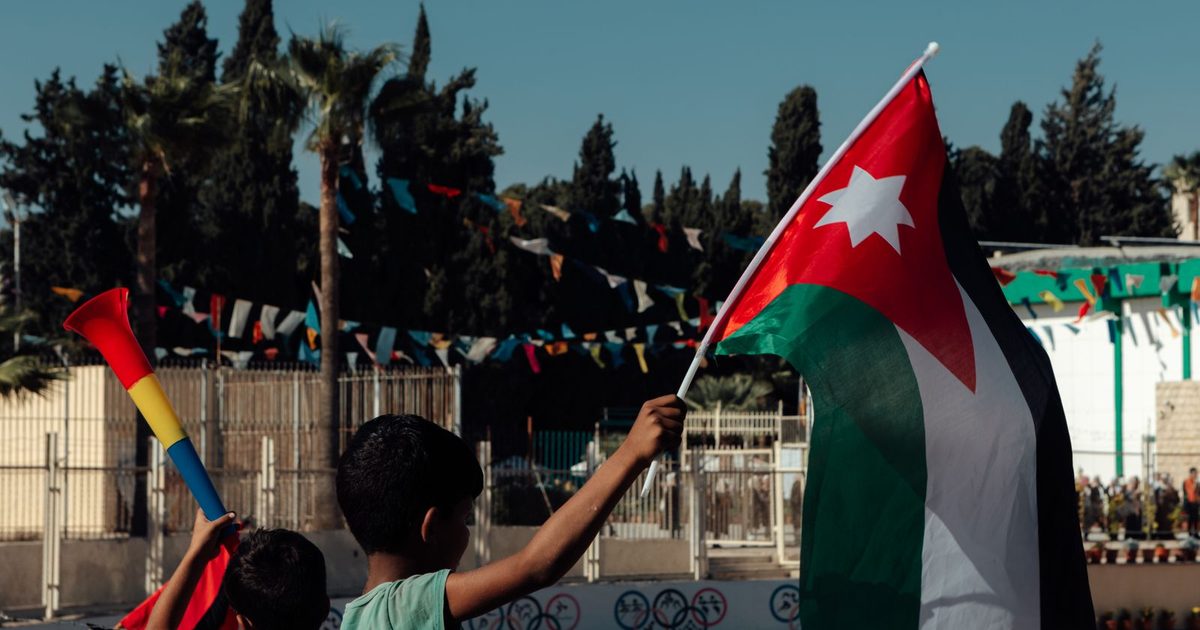
Fly into Jordan and you'll soon see its flag everywhere, and it carries real meaning. Its three horizontal bands of black, white and green recall the historic Arab caliphates, while the crimson triangle represents the Hashemite dynasty and the Great Arab Revolt of 1916, from which the modern state was born. The colours are the pan-Arab colours, a symbol of Arab unity.
On the triangle sits a white seven-pointed star, and its seven points are said to stand for the seven verses of Al-Fatiha, the opening chapter of the Qur'an, also taken to represent values such as faith, humanity and virtue. It's a flag that compresses a nation's history and beliefs into a single emblem, which is exactly why it feels so good to wear it. To say “I ❤️ Jordan” is to claim a little of all of this.
| Fact | Detail |
|---|---|
| Official name | The Hashemite Kingdom of Jordan |
| Capital | Amman |
| Population | ~11 million |
| Language | Arabic (English widely understood in tourism) |
| Currency | Jordanian dinar (JOD) |
| Government | Constitutional monarchy |
| Most famous for | Petra, a New Seven Wonder of the World |
| Also known for | Wadi Rum, the Dead Sea, hospitality, mansaf |
When to visit Jordan
The best times to visit are spring (March-May) and autumn (September-November), when the days are warm and the desert and ancient sites are comfortable to explore. Summers are hot, especially in the south and the Jordan Valley, while winters are mild by day but cold at night in the highlands, though Aqaba on the Red Sea stays warm and sunny all year, making it a winter escape even within Jordan itself.
A focused trip of five to seven days covers the classic north-to-south loop, Amman, Jerash, the Dead Sea, Petra, Wadi Rum and Aqaba, without rushing. With ten days you can slow the pace, add Madaba, Mount Nebo and the desert castles, and give Petra and Wadi Rum the extra night each truly deserves. However long you have, Jordan tends to leave you planning a return before you've even left.
Wear your love for Jordan
Explore the I ❤️ Jordan T-Shirt and review its current price, material, available sizes, and images before ordering. Cash on delivery is available inside Jordan.
Whether you were born here, travelled here, or simply fell for the place from afar, it's a way to say three small words and mean every one of them: I ❤️ Jordan.
Frequently Asked Questions
What is Jordan known for?
Why should I visit Jordan?
Is Jordan safe to visit?
What is the capital of Jordan?
What language do they speak in Jordan?
What currency is used in Jordan?
What is Jordan's national dish?
What does the Jordanian flag mean?
When is the best time to visit Jordan?
How many days do you need in Jordan?
Is Jordan expensive to visit?
What makes Jordanian hospitality special?
Put it on a shirt
 JORDAN Jordan A ready-made design you can print as it is, or change the words and colours first. Open in the designer