Jerash: Jordan's Pompeii of the East
What is Jerash, Jordan's “Pompeii of the East”? The Oval Plaza, Hadrian's Arch, the Decapolis, and how to visit one of the world's best-preserved Roman cities.
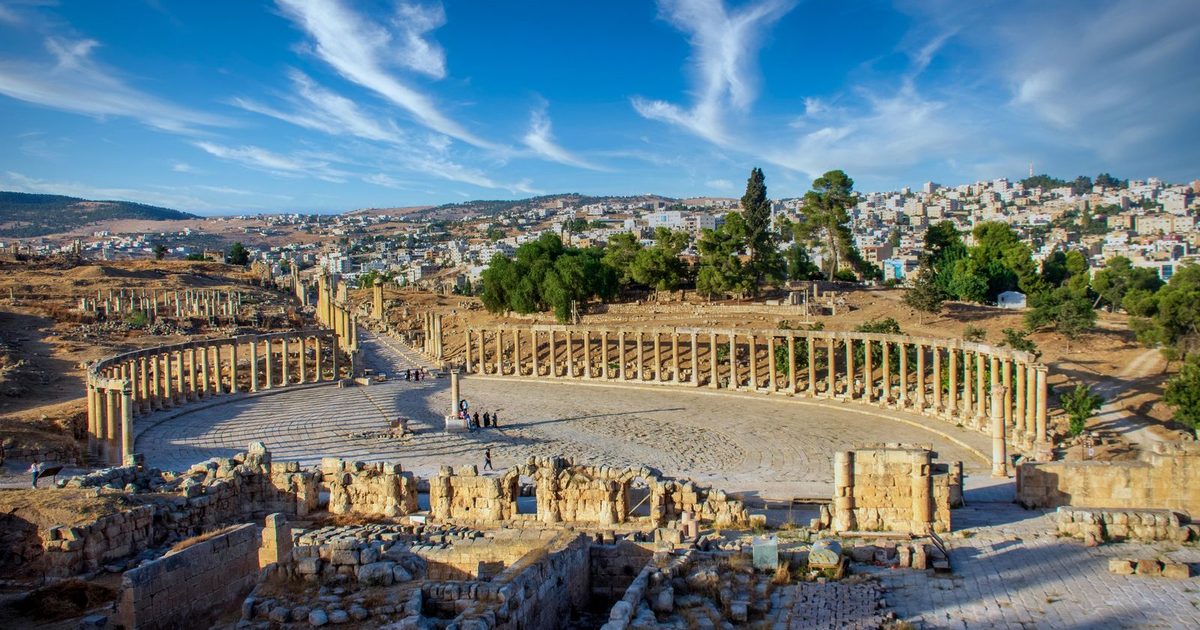
Walk through a triumphal arch built for a Roman emperor, down a colonnaded avenue still rutted by 2,000-year-old chariot wheels, into an oval plaza ringed by columns, all of it open to the sky in the green hills of northern Jordan. This is Jerash, ancient Gerasa: one of the best-preserved Roman provincial cities anywhere on Earth, and the reason it has earned the nickname the “Pompeii of the East.” Where most ancient sites give you a handful of stones, Jerash gives you a whole city.
So what exactly is Jerash, who built it, what is the famous Oval Plaza, and how do you visit? This is the full story of Jordan's great Roman city, its Decapolis past, its monuments, its long burial and rediscovery, its summer festival of music and chariot races, and how to see it for yourself, plus the Jerash T-Shirt that lets you carry a piece of it.
What is Jerash?
Jerash is an ancient city about 48 km north of Amman whose Greco-Roman ruins are among the largest and best-preserved outside Italy. Known in antiquity as Gerasa, it was one of the ten great cities of the Decapolis, a league of Greco-Roman towns on the eastern edge of the Roman world, and it grew rich on the trade that flowed between the Mediterranean coast and the caravan routes of Arabia. At its height the city is thought to have been home to around 20,000 people.
What sets Jerash apart is how complete it feels. Most ancient cities survive only as scattered foundations; here you can walk an entire urban plan, monumental gates, an oval forum, paved colonnaded streets, temples, two theatres, public baths and ornamental fountains, and actually read how a Roman provincial city worked, from its civic centre to its sacred precincts. Visit Jordan ranks it among the country's must-see sites, second only to Petra, and it draws hundreds of thousands of visitors a year.
Who built Jerash, and when?
People have lived on the site for more than 6,500 years, but the city you walk through today is overwhelmingly Roman. Gerasa was a Hellenistic foundation that truly flourished after the region came under Roman control in 63 BC under Pompey. The long peace and prosperity of the empire turned it into a confident, wealthy provincial capital.
The city reached its peak in the 2nd and 3rd centuries AD, when trade money paid for a building boom: grand temples to Zeus and Artemis, theatres, baths and the colonnaded avenues that still define it. A defining moment was the visit of Emperor Hadrian in 129-130 AD, marked by the towering triumphal arch that still greets visitors at the southern entrance. Later, as the empire became Christian, Gerasa added a remarkable series of Byzantine churches paved with intricate mosaics.
Gerasa's long decline set in after trade routes shifted and a series of earthquakes struck, the worst in 749 AD, which toppled much of the city. Over the following centuries it was gradually buried under wind-blown sand and soil, and, as at Pompeii, that burial is precisely what preserved it. The site lay largely forgotten until systematic excavations began in 1925; archaeologists are still uncovering Gerasa today.
The Oval Plaza: Jerash's signature
The image most people carry away is the Oval Plaza (or Oval Forum), a vast, elegant open space measuring roughly 90 by 80 metres, framed by a sweeping colonnade of 1st-century Ionic columns. It is widely described as the only oval-shaped forum of its kind from the Classical world, and its graceful curve, linking the main colonnaded street to the hilltop Temple of Zeus, is rightly considered a masterpiece of Roman town planning.
Many of its eight-metre columns have been carefully re-erected over decades of restoration, so standing in the centre of the plaza today gives a rare, near-complete sense of a Roman civic square, the kind of space where citizens once gathered for markets, ceremonies, politics and daily life. At sunrise or late afternoon, when the limestone glows warm and the crowds thin, it is one of the most atmospheric spots in all of Jordan.
Walking the city: Jerash's great monuments
A visit unfolds as a walk through the ancient street plan. You enter beneath Hadrian's Arch, a monumental triple gateway, and pass the Hippodrome, an arena that once held up to 15,000 spectators for chariot races. Beyond the South Gate the Oval Plaza opens out, and from it the Cardo Maximus, the colonnaded main street, runs the length of the city, its paving still scored by the wheels of Roman carts.
Off the Cardo rise the city's showpieces: the Temple of Artemis, dedicated to Gerasa's patron goddess, whose colossal columns are famous for visibly swaying in the wind without falling; the ornate Nymphaeum fountain; and the South Theatre, a 2nd-century auditorium with acoustics so precise that a voice from the stage carries clearly to the back rows. Each monument is worth lingering over, which is why the site rewards a slow, half-day visit rather than a quick loop.
Why is Jerash called the “Pompeii of the East”?
Like Pompeii in Italy, Jerash was buried and preserved, not by volcanic ash, but by centuries of sand and earth after earthquakes and decline. That long burial spared its streets, columns and public buildings from the quarrying and rebuilding that erased so many other ancient cities, so today it offers the same rare gift Pompeii does: the chance to walk an ancient city that still feels like a city rather than a ruin. Of the more than 1,000 columns the city is said to have had, dozens still stand exactly where Roman masons set them.
| Fact | Detail |
|---|---|
| Ancient name | Gerasa |
| Nickname | The “Pompeii of the East” |
| Location | Northern Jordan, ~48 km north of Amman |
| Famous as | One of the best-preserved Roman provincial cities |
| Part of | The Decapolis (league of ten Greco-Roman cities) |
| Roman peak | 2nd-3rd centuries AD |
| Key sight | The Oval Plaza (~90 × 80 m, the only oval Roman forum) |
| Rediscovered | Excavations began in 1925 (after the 749 AD earthquake) |
The Jerash Festival and the chariot races
Jerash isn't only a ruin to look at, it's still a stage. Each summer the Jerash Festival of Culture and Arts fills the ancient theatres with music, dance, theatre and poetry from across the Arab world and beyond, making it one of the region's largest cultural events; performing among 2,000-year-old columns is an experience in itself. And in the restored hippodrome, the Roman Army and Chariot Experience (RACE) re-stages legionaries drilling in formation and chariots thundering around the track, bringing the ancient arena vividly back to life for visitors.
Jerash with the rest of Jordan
Jerash sits in the cooler, greener north, which makes it an easy half-day trip from Amman and a natural pairing with the capital's own Roman ruins at the Citadel. Many travellers fit it in on the way to or from the south, where Petra's Treasury and the red sands of Wadi Rum complete the classic Jordan loop, from a living Roman city to a Nabataean wonder carved in rock to a desert that looks like another planet.
Wear the Pompeii of the East
Explore the Jerash T-Shirt and review its current price, material, available sizes, and images before ordering. Cash on delivery is available inside Jordan.
Whether you've walked the Cardo at golden hour or only seen the Oval Plaza in photographs, it's a way to keep a piece of Roman Jordan close.
The fall and rediscovery of Jerash
Jerash did not fade slowly so much as it was struck down. Having flourished under the Romans and then the Byzantines, who built a string of churches with fine mosaic floors among the older temples, the city was devastated by a catastrophic earthquake in 749 AD. Much of it collapsed, the population dwindled, and over the centuries wind-blown sand and soil gradually buried the ruins, which is precisely why so much of the city survived intact beneath the surface.
For roughly a thousand years Jerash lay largely forgotten by the outside world, until the German explorer Ulrich Jasper Seetzen identified the site in 1806. Systematic excavation began in the 1920s and continues today, steadily lifting the buried streets, temples and theatres back into the light. It is this long sleep under the sand, and the careful digging that followed, that gives modern visitors such a complete Roman city to walk through.
Visiting Jerash: getting there and when to go
Jerash sits about 48 kilometres north of Amman, an easy 60-90 minute drive that makes it one of the most popular day trips from the capital, reached by rental car, private driver or organised tour. You enter through the monumental Hadrian's Arch, passing the hippodrome before reaching the Oval Plaza, and a thorough visit takes two to three hours of walking, comfortable shoes and, in the warmer months, a hat and water are well worth bringing.
The best seasons are spring and autumn, when the northern hills around Jerash turn green and the temperatures are kind for exploring open ruins on foot. If you can time your trip to the summer Jerash Festival, you'll see the ancient theatres used much as they were intended; otherwise the early morning, before the tour buses arrive, is the most atmospheric and photogenic time to have the colonnaded street almost to yourself.
Frequently Asked Questions
What is Jerash?
Where is Jerash located?
Why is Jerash called the Pompeii of the East?
How old is Jerash?
What is the Oval Plaza in Jerash?
Who built Jerash?
What is the Decapolis?
What can you see in Jerash?
How far is Jerash from Amman?
How long do you need to visit Jerash?
What is the Jerash Festival?
Is Jerash worth visiting?
Put it on a shirt
 JERASHROMAN JORDAN Jerash A ready-made design you can print as it is, or change the words and colours first. Open in the designer