Aqaba: Jordan's Window on the Red Sea
A guide to Aqaba, Jordan's Red Sea city, world-class diving and coral reefs, the Cedar Pride wreck, the Mamluk castle and ancient Ayla, and the great Arab Revolt flag.
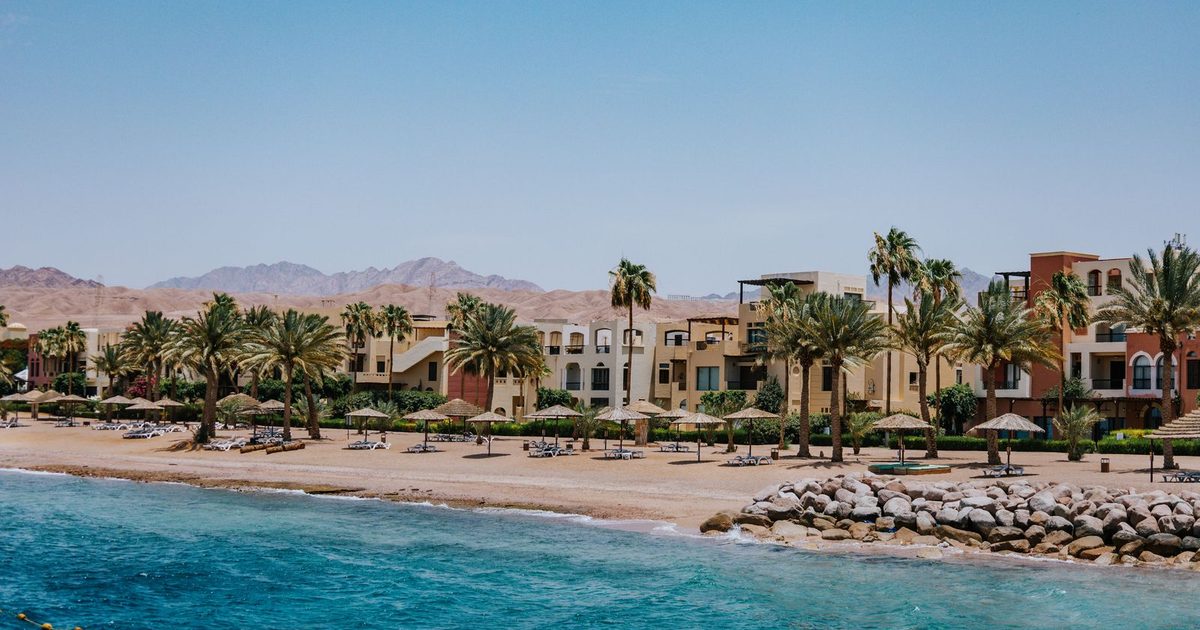
Slip off a beach lined with palm trees, lower your face into warm, glass-clear water, and a coral reef bursts into colour just metres from shore, clownfish, parrotfish and the occasional turtle drifting over gardens of coral that have grown here for centuries. This is Aqaba, Jordan's only coastal city and its window on the Red Sea: a warm, year-round beach town that is also one of the finest and most accessible dive destinations on Earth.
So what is Aqaba, what is there to do, and why does a small city on a sliver of coast matter so much to Jordan? This is the full story of the Kingdom's Red Sea gateway, its coral reefs and famous shipwreck, its Mamluk castle and the ruins of ancient Ayla, the great flag of the Arab Revolt, its tax-free beach resorts, and how it anchors the south, plus the Aqaba T-Shirt that lets you wear a piece of it.
Where is Aqaba?
Aqaba sits at the very southern tip of Jordan, on the Gulf of Aqaba, the north-eastern arm of the Red Sea. It is the country's only coastal city and its only seaport, Jordan's entire coastline is just 27 kilometres long, which makes this short, precious stretch of shore disproportionately important to the nation as a port, a resort and a strategic outlet to the sea.
The setting is remarkable: from Aqaba's beaches you can look across the gulf and see four countries at once, Jordan, Israel's resort of Eilat right next door, Egypt's Sinai mountains, and the coast of Saudi Arabia. Bare red-brown mountains rise straight behind the city, the same desert ranges that roll inland to Wadi Rum, so the contrast of stark desert and brilliant turquoise sea is everywhere you look. Visit Jordan calls it the country's premier Red Sea resort.
Diving and coral reefs in the Red Sea
Aqaba's greatest treasure is underwater. The Gulf of Aqaba holds some of the northernmost coral reefs in the world, and because the water is warm, clear and calm almost all year, conditions for diving and snorkelling are superb. Many of the reefs sit close to shore, so even snorkellers wading in from the beach can hover over living coral gardens teeming with fish, no boat required.
The marine life is extraordinary for such a small area: hundreds of species of fish, soft and hard corals in vivid colours, rays, moray eels, seahorses and turtles. Crucially, these reefs have stayed relatively healthy, and Jordan protects much of the coast within the Aqaba Marine Park. With water temperatures rarely dropping below the low twenties Celsius, Aqaba offers comfortable diving when much of the world's coast is cold, one reason divers return again and again.
Wrecks and underwater attractions
Beyond the natural reefs, Aqaba has deliberately built one of the most unusual diving menus anywhere. Its most famous site is the Cedar Pride, a cargo ship deliberately sunk in 1985 to create an artificial reef; now draped in coral and circled by fish, it is a magnet for divers. Nearby lies an extraordinary underwater military museum, where decommissioned tanks, an anti-aircraft gun, a helicopter and other vehicles have been sunk in battle formation on the seabed for divers to explore.
Add the colourful coral of sites like the Japanese Garden and the Power Station, plus a sunken aircraft, and Aqaba packs reefs, wrecks and curiosities into a compact, easy-to-reach coastline. Dive centres along the shore cater to everyone from first-timers taking an introductory dive to certified divers chasing the deeper wrecks, and many sites are gentle enough for families snorkelling from the beach.
Aqaba Castle and ancient Ayla
Aqaba is far older than its resorts. On the waterfront stands Aqaba Castle (the Mamluk fort), rebuilt in the early 16th century and later used as a khan, or rest house, for pilgrims journeying to Mecca; its square walls and gateway are a reminder of the city's long role as a crossroads. Beside it, the small Aqaba Archaeological Museum tells the story of the coast.
Just along the shore lie the excavated ruins of Ayla, one of the earliest Islamic cities, founded in the 7th century as a planned port town with walls, gates and a central street still traceable today. Long before that, the same site was the biblical harbour region of Elath and Ezion-Geber, from which, tradition holds, ships set out on Red Sea trade. Aqaba has been a working port, in one form or another, for well over three thousand years.
The Arab Revolt and the great flagpole
Aqaba holds a special place in modern Arab history. In July 1917, during the Arab Revolt of the First World War, Arab forces with T. E. Lawrence, “Lawrence of Arabia”, captured the town in a daring surprise attack from the desert behind it, having crossed Wadi Rum, rather than from the heavily defended sea. The fall of Aqaba was a turning point in the revolt and a story made famous around the world.
That heritage flies overhead today. Above the castle rises the Aqaba Flagpole, for years one of the tallest free-standing flagpoles on Earth at around 130 metres, carrying the enormous flag of the Arab Revolt, its black, white, green and red bands visible from far out at sea and across the gulf in neighbouring countries. It is the city's defining landmark and a proud national symbol.
| Fact | Detail |
|---|---|
| What it is | Jordan's only coastal city and seaport |
| On | The Gulf of Aqaba, north-eastern Red Sea |
| Coastline | Just ~27 km, all of Jordan's seafront |
| Famous for | Coral reefs, diving and the Cedar Pride wreck |
| Underwater | Military museum of sunken tanks and vehicles |
| History | Mamluk castle, ancient Ayla, the Arab Revolt (1917) |
| Landmark | The Arab Revolt flag on a ~130 m flagpole |
| Climate | Warm and sunny year-round, a winter beach city |
A year-round beach city
Thanks to its sheltered position and desert climate, Aqaba is warm and sunny even in winter, making it Jordan's go-to escape when Amman is cold. Summers are hot, but the sea stays inviting, and the city's beaches range from free public stretches to the manicured shores of resorts at Tala Bay and the Ayla lagoon development just outside town. Add boat trips, glass-bottom boats and waterfront seafood, and Aqaba works equally well as a relaxed family beach holiday or a diving base.
Aqaba is also a special economic zone (ASEZ), with low taxes and duty-free shopping that make it popular for a spot of retail alongside the sun. The compact city centre, with its souks, cafés and fish restaurants, is easy to explore on foot, and the relaxed, friendly atmosphere is a noticeable change of pace from the capital. The best months for sea and sun are spring and autumn, though the water is divable all year.
What to do in Aqaba
Aqaba rewards a couple of days of sea and history before or after the desert:
- Dive or snorkel the reefs, shore-accessible coral gardens and the Aqaba Marine Park.
- The Cedar Pride wreck & underwater military museum, Aqaba's signature dives.
- Aqaba Castle & the flagpole, the Mamluk fort and the Arab Revolt flag on the waterfront.
- Ancient Ayla, the ruins of one of the first Islamic cities, right by the shore.
- A boat trip on the gulf, glass-bottom or private boats to see reefs and four coastlines.
- Beaches & resorts, public beaches in town or the calm shores of Tala Bay and Ayla.
Aqaba: gateway to Jordan's south
Aqaba is the natural anchor of southern Jordan. The desert of Wadi Rum is only about an hour's drive inland, and the rose-red city of Petra around two hours north, making the classic combination of sea, desert and ancient city an easy loop. With its own international airport and a ferry link to Egypt, Aqaba is also a common start or end point for a whole Jordan trip, many travellers fly into Amman and out of Aqaba, or the reverse.
Wear the Red Sea
Explore the Aqaba T-Shirt and review its current price, material, available sizes, and images before ordering. Cash on delivery is available inside Jordan.
Whether you've floated over the coral or only dreamed of the Red Sea's blue, it's a way to keep a piece of Jordan's coast close.
Frequently Asked Questions
What is Aqaba?
Where is Aqaba located?
Is Aqaba good for diving and snorkelling?
What is the Cedar Pride?
Is there really an underwater military museum in Aqaba?
What is the giant flag in Aqaba?
What happened at Aqaba in 1917?
Is Aqaba worth visiting?
When is the best time to visit Aqaba?
How far is Aqaba from Wadi Rum and Petra?
Can you swim in the sea at Aqaba?
Why is Aqaba important to Jordan?
Put it on a shirt
 AQABARED SEA Aqaba A ready-made design you can print as it is, or change the words and colours first. Open in the designer