Amman: Jordan's Capital of Hills and History
A guide to Amman, Jordan's capital, the Citadel and Temple of Hercules, the Roman Theatre, its three ancient names, the white city on the hills, and what to do.
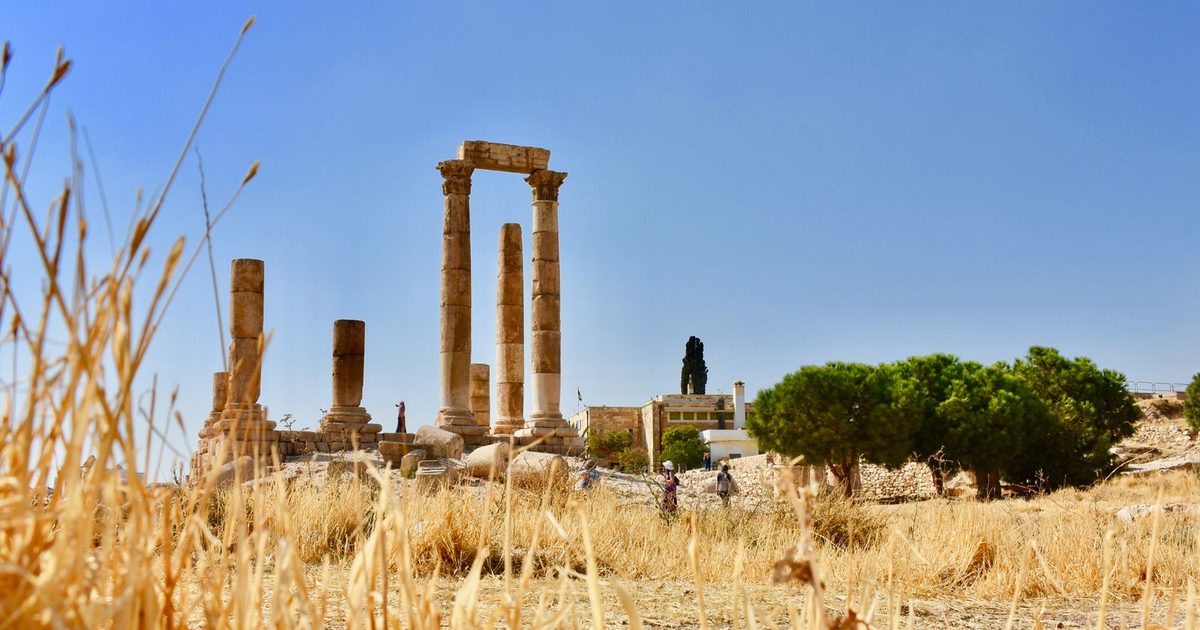
Roman columns crown a hilltop above a sea of pale, boxy houses that climb every slope as far as you can see; down below, a 2,000-year-old theatre is carved into one hillside while the call to prayer and the hum of traffic rise from the next. This is Amman, the capital of Jordan, a city built on hills, layered with three civilisations' worth of history, and the gateway through which almost every visitor to the country arrives.
So what is Amman, what should you see there, and why does it have three different ancient names? This is the full story of Jordan's capital, its hilltop Citadel and Temple of Hercules, its great Roman Theatre, its journey from Ammonite stronghold to modern Arab metropolis, its famous white limestone skyline, when to go and how to get around, plus the Amman T-Shirt that lets you wear a piece of it.
What is Amman?
Amman is the capital and largest city of Jordan, and the political, cultural and economic heart of the country, home to roughly four million people, close to half the national population. It sits in the hills of north-central Jordan, and for most travellers it is the arrival point and natural base: the airport, the museums, the embassies and the best food scene in the country are all here. It is also one of the oldest continuously inhabited cities in the world, with traces of settlement stretching back thousands of years.
First impressions are of a city of hills built almost entirely in pale, sand-coloured limestone, which has earned it the nickname the “white city.” Steep streets and long public staircases connect neighbourhood to neighbourhood, and from almost any high point the view is an endless, light-toned cityscape rolling over the slopes. Visit Jordan describes a capital where ancient ruins, busy souks and modern galleries all share the same hills, often within a single block.
The Citadel and the Temple of Hercules
The best place to grasp Amman is the Citadel, Jabal al-Qal'a, the flat-topped hill at the city's heart that has been fortified and built upon for thousands of years. Its skyline-defining landmark is the Temple of Hercules, whose towering Roman columns are one of the symbols of the city; nearby lie the giant fragments of a colossal statue, including a marble hand, hinting at how monumental the temple once was.
The Citadel is a layer-cake of empires. Alongside the Roman temple stand the domed Umayyad Palace complex from the early Islamic period and the remains of a Byzantine church, with Bronze Age and Iron Age foundations beneath. The on-site Jordan Archaeological Museum and the sweeping 360-degree view over the city and the Roman Theatre below make it the single most rewarding stop in Amman. Go in the late afternoon, when the low sun warms the stone and the white city glows beneath you.
The Roman Theatre
Cut steeply into a hillside in the heart of downtown, the Roman Theatre is Amman's other great ancient monument. Built in the 2nd century AD when the city was the Roman Philadelphia, it could seat around 6,000 spectators, and its raked stone tiers are so well preserved that it is still used for concerts and events today. Climbing to the top row for the view, and testing the famous acoustics, is a rite of passage.
The theatre was built into the hill so that the rows faced north, keeping the audience shaded from the sun. The plaza in front, flanked by the smaller Odeon and the columns of a Roman forum, is a favourite gathering spot where families, street vendors and musicians come together in the evenings. Two small folklore museums tucked into the wings display traditional Jordanian dress, jewellery and crafts, making the site an easy introduction to the country's living culture as well as its ancient stones.
Three names: Rabbath Ammon, Philadelphia, Amman
Few cities have carried as many names. In antiquity the hill city was Rabbath Ammon, capital of the Ammonites, and it appears repeatedly in the Hebrew Bible. In the 3rd century BC the Ptolemaic ruler Ptolemy II Philadelphus rebuilt it and renamed it Philadelphia, “city of brotherly love”, and under that name it became one of the cities of the Greco-Roman Decapolis, the same league as Jerash.
The ancient name Amman, echoing the Ammonites, eventually returned. The modern city, though, is surprisingly young: Amman was a small village when it was chosen as the capital of the new Emirate of Transjordan in 1921, and it has grown explosively into a regional metropolis within a single century, which is why Roman ruins and glassy towers sit so close together. Waves of newcomers over the decades have given the capital a famously mixed, open character.
The white city on the hills
Amman was originally said to be built, like Rome, across seven hills (jebels); today it sprawls over many more, and the names of those hills, Jabal Amman, Jabal al-Weibdeh, Jabal al-Hussein, still serve as the names of its districts. Building regulations long favoured the local cream-coloured limestone, giving the whole city its uniform, light-toned look that glows softly at sunset. The result is a cityscape unlike any other Arab capital.
Living on such steep terrain has shaped daily life in small, memorable ways. Long public staircases climb between neighbourhoods as shortcuts that cars can't take, and some, like the painted steps off Rainbow Street and in Jabal al-Weibdeh, have become open-air art galleries and meeting places in their own right. Learning to read the city by its hills, rather than by a flat grid of streets, is part of getting to know Amman.
Downtown, Rainbow Street and modern Amman
Below the Citadel lies downtown, al-Balad, the old commercial core of souks, spice shops, gold sellers, juice stands and the famous Hashem and Habibah eateries, gathered around the Roman Theatre and the Grand Husseini Mosque. It's the most atmospheric, walkable part of the city and the best place to eat falafel, hummus and knafeh.
Up the hill, Jabal Amman and Rainbow Street offer a different mood: galleries, cafés, boutiques and rooftop bars, busiest on summer evenings and during the weekly souk Jara market. Elsewhere the blue dome of the King Abdullah I Mosque rises over the skyline. Amman's real signature, though, is its people: the city has a deserved reputation for warmth and hospitality, and a meal here almost always comes with an invitation to stay longer.
| Fact | Detail |
|---|---|
| What it is | The capital and largest city of Jordan |
| Population | ~4 million (about half of Jordan) |
| Ancient names | Rabbath Ammon, then Philadelphia (Decapolis) |
| Nickname | The “white city”, built in pale limestone |
| Built on | Originally seven hills (jebels); now many more |
| Top sight | The Citadel (Temple of Hercules, Umayyad Palace) |
| Also famous for | The 2nd-century Roman Theatre (~6,000 seats) |
| Role for visitors | Jordan's arrival point and natural travel base |
When to visit and getting around
The best times to visit Amman are spring (March-May) and autumn (September-November), when the hilltop air is warm and clear. Sitting high above sea level, the capital is cooler than the Jordan Valley year-round; summer days are hot but dry, and winter can be genuinely cold, with the occasional dusting of snow on the jebels. Pack a layer for the evenings whatever the season.
Getting around is easiest by taxi or the Careem ride app, both cheap and widely used; the historic core of downtown and the Citadel is best explored on foot, though be ready for the hills. Amman is also Jordan's transport hub: the airport lies south of the city, and intercity JETT buses, private drivers and rental cars all radiate from the capital to the rest of the country.
What to do in Amman
Amman rewards a day or two before you head out to the rest of the country:
- The Citadel (Jabal al-Qal'a), Temple of Hercules, Umayyad Palace and the city's best viewpoint.
- The Roman Theatre, climb the tiers and visit the folklore museums beside it.
- Downtown (al-Balad), souks, the Husseini Mosque, and street food at Hashem and Habibah.
- Rainbow Street & Jabal al-Weibdeh, cafés, galleries and the artsy side of the city.
- King Abdullah I Mosque, the striking blue-domed mosque, open to visitors.
- Museums, the Jordan Museum (home to the Dead Sea Scrolls and the Ain Ghazal statues) tells the country's whole story.
Amman as your base in Jordan
Because almost everything in Jordan is within a few hours' drive, Amman makes the ideal hub. From here you can day-trip to the Roman ruins of Jerash in the green north or float in the Dead Sea to the west, then head south to Petra and the desert of Wadi Rum. Most Jordan itineraries begin and end in the capital.
Closer at hand, a single easy day combines the mosaics of Madaba, the view from Mount Nebo and the Baptism Site on the Jordan River, all less than an hour from the city, proof that Amman is not just a place to pass through, but a comfortable home base for exploring the heart of the country.
Wear the capital
Explore the Amman T-Shirt and review its current price, material, available sizes, and images before ordering. Cash on delivery is available inside Jordan.
Whether you've watched the sunset turn the white city gold or only know it from photographs, it's a way to keep a piece of Jordan's capital close.
Frequently Asked Questions
What is Amman?
What are the main things to see in Amman?
Why is Amman called the white city?
What was Amman called in ancient times?
What is the Amman Citadel?
How old is the Roman Theatre in Amman?
Is Amman worth visiting?
How many days do you need in Amman?
When is the best time to visit Amman?
Is Amman safe for tourists?
What food is Amman known for?
How do I get around Amman?
How do I get from Amman to Petra or Wadi Rum?
Put it on a shirt
AMMAN Amman A ready-made design you can print as it is, or change the words and colours first. Open in the designer