The Dead Sea: Floating at the Lowest Point on Earth
What is the Dead Sea, the lowest point on Earth? Why you float, the healing minerals and mud, the shrinking shoreline, and how to visit Jordan's salt sea.
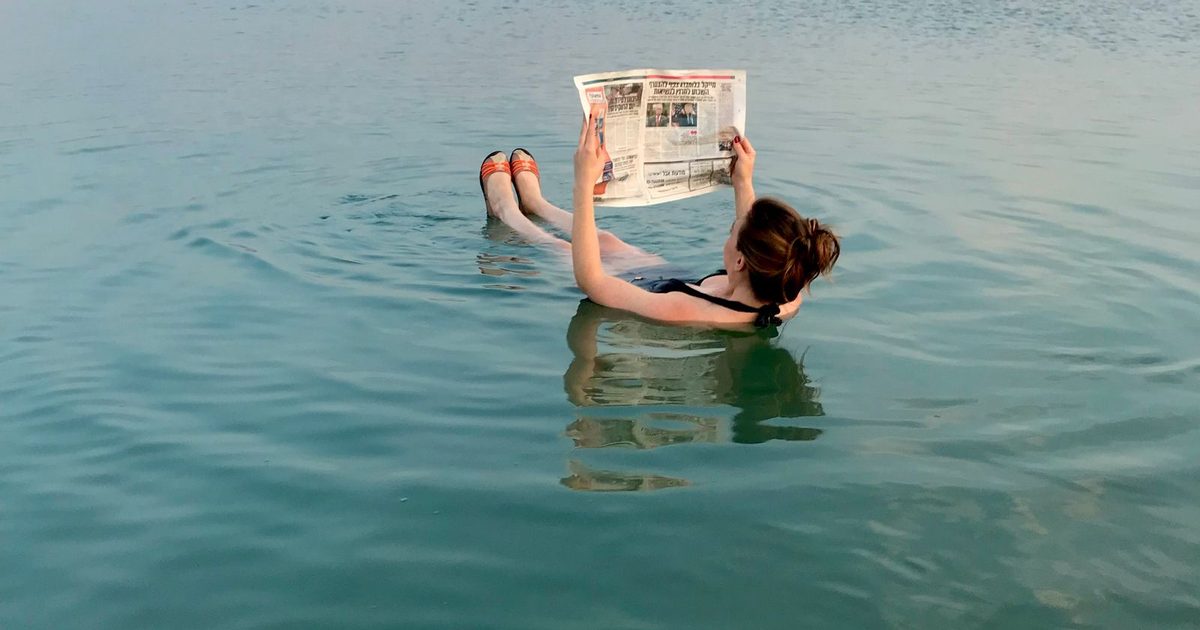
Wade in up to your waist, lean back, and the water simply refuses to let you sink, you bob on the surface like a cork, free to read a newspaper or take a photograph with both feet in the air. This is the Dead Sea: a hypersaline lake cradled between Jordan and Palestine, and the lowest point on the surface of the Earth. There is genuinely nowhere else on the planet quite like it, and Jordan's eastern shore is one of the best places to experience it.
So what exactly is the Dead Sea, why can't you sink in it, why is it called “dead,” and how do you visit? This is the full story of Jordan's salt sea, the science of its impossible buoyancy, its 21 minerals and famous healing mud, its place in ancient history, the slow crisis of its shrinking shoreline, and how to make the most of a visit, plus the Dead Sea T-Shirt that lets you wear a piece of it.
What is the Dead Sea?
The Dead Sea is a landlocked salt lake on the border between Jordan to the east and Israel and the West Bank to the west, fed mainly by the Jordan River. It is not really a sea at all but a terminal lake, water flows in, but the only way out is evaporation under the fierce desert sun, which leaves the salts and minerals behind and concentrates them to extraordinary levels.
Its surface sits at roughly 430 metres below sea level, making both the lake and its shores the lowest dry land on Earth. The setting is striking: a band of impossibly blue, oily-calm water below bare, sun-baked hills, with Jordan's resorts strung along the eastern shore around Sweimeh, about an hour's drive from Amman. Britannica describes it as one of the world's saltiest and most unusual bodies of water.
Why can't you sink in the Dead Sea?
The answer is salt. Ordinary seawater is about 3.5% salt; the Dead Sea is around 34% salt and minerals, roughly ten times saltier. That makes the water far denser than your body, so it pushes you upward with enough force that floating is effortless and sinking is genuinely impossible. You don't swim in the Dead Sea so much as recline in it, and most first-timers can't stop laughing at the strangeness of it.
That same density comes with rules. The water stings any cut, and it is painful, even dangerous, in the eyes and mouth, so you float on your back and keep your face dry; don't dunk your head or splash. It's also wise not to shave for a day or two beforehand. And because swallowing the water is harmful, the Dead Sea is for floating, not for swimming laps. Showers are always close by on the resort beaches for rinsing off afterwards.
Why is it called the “Dead” Sea?
The name comes from biology: the water is so salty that fish and plants cannot survive in it, there is no seaweed, no fish, nothing splashing. Only a few hardy microbes live in the brine. To ancient peoples a sea with no visible life was simply “dead,” and the name has stuck for thousands of years. Ironically, that lifeless water is exactly what makes the lake so good for human skin.
The minerals and the healing mud
The Dead Sea holds an unusually rich cocktail of around 21 minerals, including high concentrations of magnesium, potassium, calcium and bromine, and a number of them occur here in proportions found nowhere else on Earth. This mineral load, together with the black mud along the shore, has given the lake a reputation for healing that stretches back to antiquity.
Visitors slather themselves in the mineral-rich mud, let it dry in the sun, then rinse it off in the lake, a ritual that is half spa treatment, half rite of passage. The water and mud are widely believed to soothe skin conditions such as psoriasis and eczema and to ease aching joints, and the region has built a whole wellness-tourism industry, and a global cosmetics trade, around its minerals. Even if you're sceptical of the claims, your skin will feel remarkably soft afterwards.
The lowest point on Earth
At about 430 metres below sea level, the Dead Sea region is the lowest place a person can stand on dry land anywhere on the planet, a fact Jordan marks with a “Lowest Point on Earth” museum near the shore. Standing there, you are literally as far below the world's oceans as it is possible to walk.
That extreme depth changes the very air and light. The thick layer of atmosphere overhead is richer in oxygen and filters more of the sun's harshest ultraviolet rays, so sunbathing here is gentler on the skin than the blazing climate suggests, though the heat is real, and sunscreen and water are still essential. The combination of warm, mineral-laden air and filtered light is part of why doctors have long sent patients here.
A sea steeped in history
Few lakes carry as much history. The Dead Sea appears throughout the Bible: the cities of Sodom and Gomorrah are traditionally placed near its shores, and Lot's Cave, above the south-eastern coast in Jordan, is venerated as the refuge of Lot after their destruction. The hills nearby also shelter sites tied to prophets and pilgrims, and the Baptism Site of Jesus at Bethany-beyond-the-Jordan lies a short drive north.
The lake fascinated the ancient world too. The Greeks and Romans knew it as Lake Asphaltites, after the lumps of natural asphalt (bitumen) that floated up from its bed and were prized for waterproofing and embalming. Aristotle wrote about its strange buoyancy, and Cleopatra is said to have coveted its shores for their cosmetics and balsam. To stand on its banks is to share a view that has drawn people for millennia.
| Fact | Detail |
|---|---|
| What it is | A hypersaline terminal lake (not a true sea) |
| Location | Between Jordan (east) and Israel/West Bank (west) |
| Elevation | ~430 m below sea level, Earth's lowest dry land |
| Salinity | ~34%, about 10× ordinary seawater |
| Minerals | ~21, including magnesium, potassium, calcium, bromine |
| Why you float | Extreme salt density makes the water far denser than you |
| Why “dead” | Too salty for fish or plants to live |
| Jordan shore | Resorts around Sweimeh, ~1 hour from Amman |
The shrinking sea
The Dead Sea is also a place under pressure. Because so much water is now diverted from the Jordan River for farming and drinking before it ever reaches the lake, far less flows in than evaporates out, and the surface has been dropping by around a metre a year for decades. The shoreline that visitors once stepped straight into has retreated, and many older beach buildings now sit well back from the water.
The falling level has a dramatic side effect: thousands of sinkholes have opened along the exposed shore as freshwater dissolves underground salt layers. Engineers and the governments around the lake have long discussed projects to channel water from the Red Sea to slow the decline, but the Dead Sea's future remains uncertain, which is part of why so many travellers feel a quiet urgency to float in it while they can.
What to do at the Dead Sea
Most visitors come for the float, but Jordan's shore offers more than a quick dip:
- Float (and read a newspaper), the classic, recline on your back and let the water hold you up.
- The mud ritual, coat yourself in mineral mud, dry in the sun, rinse off in the lake.
- Spa & wellness, the resorts at Sweimeh are built around Dead Sea spa treatments.
- Lowest Point on Earth Museum, on the region's geology, ecology and archaeology.
- Lot's Cave & Bab edh-Dhra, biblical and Bronze Age sites above the south-eastern shore.
- Wadi Mujib, the dramatic “Grand Canyon of Jordan,” whose Siq trail ends near the Dead Sea.
The Dead Sea in a Jordan trip
The Dead Sea is an easy day trip or relaxing overnight from Amman, and it pairs naturally with the mosaics of Madaba, Mount Nebo and the Baptism Site nearby. Many travellers use it as the soothing counterpoint to the rest of a Jordan loop, a float at the lowest point on Earth to recover after the climb through Petra and a night in the desert of Wadi Rum.
Wear the lowest point on Earth
Explore the Dead Sea T-Shirt and review its current price, material, available sizes, and images before ordering. Cash on delivery is available inside Jordan.
Whether you've floated at the world's lowest point or only seen it in photographs, it's a way to keep a piece of this one-of-a-kind place close.
Frequently Asked Questions
What is the Dead Sea?
Why do you float in the Dead Sea?
Where is the Dead Sea located?
Why is it called the Dead Sea?
How deep below sea level is the Dead Sea?
Is the Dead Sea good for your skin?
Can you swim in the Dead Sea?
Is the Dead Sea safe to visit?
Why is the Dead Sea shrinking?
What else is there to do at the Dead Sea?
How far is the Dead Sea from Amman?
Is the Dead Sea worth visiting?
Put it on a shirt
 DEAD SEALOWEST ON EARTH Dead Sea A ready-made design you can print as it is, or change the words and colours first. Open in the designer